



Treatment of advanced prostatitis - chronic and acute - is a complex undertaking that requires the parallel use of a number of different medications.
Each specific case individually creates the necessary list of drugs, depending on the patient's medical history, the course of the disease and a number of other important factors.
Types of drugs
The selection of cheap but effective drugs for prostatitis is based on understanding the causes of the disease and the characteristics of its manifestation, however, antibiotics and anti-inflammatory drugs should be considered the main aspects of any list of drugs.Moreover, if the latter can be of a general nature, then it is advisable to prescribe antibiotic therapy taking into account the counteraction to a specific type of pathogen identified as a result of the analysis.
Also, anti-prostatitis medications can be used in therapy, such as different types of antipyretics, pain relievers, diuretics, alpha-blockers, antispasmodics, antiandrogens and laxatives.
Modern drugs can be classified not only according to their intended purpose, but also according to the form of release:
- injections (shots):treatment of inflammation of the prostate gland with injections is justified, first of all, in the case of a serious condition of the patient that requires immediate stabilization.As a rule, drugs concentrated in ampoules are diluted to obtain a solution, after which they are prescribed for intramuscular or intravenous infusion;
- candles:Medicines in the form of suppositories are important during the routine treatment of chronic prostatitis or as medicines for the prevention of prostatitis.In some cases, suppositories are prescribed to increase potency, since the absorption of the substance from the intestinal mucosa ensures its better penetration into the prostate tissue;
- tablets and capsules:these medicinal forms are the most common in the standard treatment regimen for chronic or acute prostatitis.Tablets are easy to dose and convenient to take, so most antibiotics, anti-inflammatories and decongestants (alpha-blockers or 5-alpha-reductase inhibitors) are produced in this form;
- instillation:This is a treatment method that is not often practiced for prostatitis, the essence of which is to inject a medicinal solution into the urethra or bladder using a special syringe.The main purpose of instillations is to restore damaged mucous membranes, destroy pathogenic microflora and suppress inflammatory processes;
- micro enema:small cold enemas reduce local swelling, inflammation and pain in the prostate gland, although at the same time they impair the transport of drugs into its tissues.In the final stages of therapy and after recovery, courses of microenemas with solutions based on herbal preparations can be carried out.When the liquid is kept in the intestine for a long enough time, its mucosa absorbs useful substances;
- plaster:Skin patches, such as microclymas, are auxiliary measures in the treatment of the prostate and rather have a supportive effect on the body, complementing the full drug therapy.
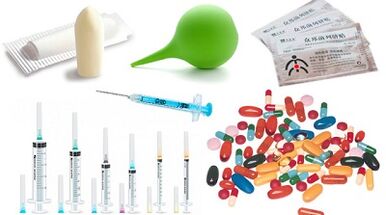
When choosing a dosage form of a drug, you should consider, in addition to the patient's condition, his preferences.
Some patients have problems swallowing tablets, while others are contraindicated for rectal suppositories due to the presence of inflammatory diseases in the anorectal area.
Factors such as the availability and cost of drugs also play an important role - it is not always possible to find a fast-acting and cheap drug for prostatitis, so you have to take less effective analogues.
Antibiotics
The selection of antibiotics requires a selective approach, since it is important to choose a drug that suppresses a specific type (or types) of pathogenic agents of inflammatory prostatitis.Why do doctors study urethral swabs, urinalysis, and prostate secretion samples?
It is highly desirable to use antibacterial antibiotics that have bacteriostatic and bactericidal effects, so that the drug not only blocks the spread of infection, but also actively destroys dangerous microorganisms.
Beta-lactam antibiotics, such as aminoglycosides, are less preferred, although they are inexpensive.Unlike fluoroquinolones and macrolides, they are characterized by a poor ability to penetrate the tissue of the prostate gland and create the necessary concentrations of the active substance in it.
Fluoroquinolones are powerful bactericidal drugs, significantly higher than bacteriostatic agents in this parameter.
Alpha blockers
This group of drugs is actively used not only for prostatitis, but also for prostate adenoma, and their effectiveness is based on blocking alpha-adrenergic receptors to prevent their contact with norepinephrine and adrenergic agonists.As a result, the receptors in the vessels do not receive vasoconstrictor nerve signals, due to which their expansion is achieved with a subsequent improvement of blood circulation.
It should be noted that selective alpha1-adrenergic blockers are actively used in urology, which act on receptors in the tissues of the bladder, prostate and urinary tract.
Reducing tissue swelling not only improves urodynamics, but also tones up the entire male genitourinary system, helping, among other things, to remove impotence and reduced erection.
Anti-inflammatory medications

Prostatitis in men is treated with the use of non-steroidal anti-inflammatory drugs (NSAID/NSAIDs), which meet the requirements of effectiveness, but at the same time, are safe for the body.
The purpose of these drugs is to suppress the inflammatory process affecting the prostate and possibly the seminal vesicles, bladder neck and distal urinary tract.
After a decrease in the clinical severity of prostate inflammation, the normalization of the patient's condition is observed, including a decrease in body temperature, a decrease in swelling of the prostate gland, elimination of urinary tract obstruction and suppression of pain in the anogenital area.
Hormonal drugs
The use of hormonal drugs in the treatment of prostatitis is allowed only in the case of an advanced chronic course of the disease, in which antibiotics, alpha-blockers and anti-inflammatory drugs are not able to normalize disturbed hormonal levels.
Depending on the goals, the patient can be prescribed both androgens, which increase the level of male hormones (testosterone) in the blood, and estrogens, which suppress the production of dihydrotestosterone, which provokes the proliferation of prostate tissue.
All hormonal medications are sold strictly by prescription and must be used exclusively as prescribed by the attending physician, as the wrong or premature dosage can have a harmful effect on the patient's health.
Immunomodulators
The complicated course of acute prostatitis is aggravated by the development of immunosuppression, which can be intensified under the influence of a number of antibiotics and other drugs.For this reason, there is a need to strengthen the body's resistance to pathogenic microflora, which is carried out with the help of immunostimulants.
There are many different medicines of this type.
Do not forget that vitamins A, C and E also help to strengthen the immune system, so experts recommend the active consumption of foods containing these substances in large quantities.
Analgesics

Painkillers are usually needed in the early stages of therapy, when the treatment has not yet had time to functionally improve the state of the prostate, which is why the patient experiences pain during urination, defecation, sitting for a long time on a hard surface or physical activity.
Typically, moderate-strength analgesics taken as prescribed one to three times daily are sufficient.
These products have many structural analogues (generics), and they are produced by many companies, but doctors advise not to pay too much for the brand.
Muscle relaxants
From the class of muscle relaxants, in urology it is customary to prescribe antispasmodics - drugs that help relax smooth muscles that are in a state of spasm.This therapy is effective for acute prostatitis, which causes involuntary spasms of the muscles of the prostate and the entire pelvic floor.
The course of using antispasmodics is unnecessary: it is enough to take them in moderate doses during the first days or weeks of general therapy.Also, these drugs should not be abused to avoid the risk of dysfunction of the relevant body organs and systems.
vegetable
Herbal remedies prescribed for prostatitis are most often dietary supplements, available in the form of rectal suppositories, capsules or tablets.
Among the well-known extracts that form the basis of such preparations are the bark of the African plum, the fruits of the creeping (or dwarf) palm and the herb Tribulus creeping.A little less used is an extract from the prostate gland of animals (animals).
There is also a group of medicines such as homeopathic medicines for the treatment of prostate inflammation.
For the prevention of prostatitis
Prevention of prostatitis requires, first of all, maintaining a healthy lifestyle, including regular sexual activity.But to maintain tone, you can also use various medicines - as a rule, we are talking about dietary supplements of herbal origin.
Since the manufacturers of these dietary supplements claim their ability to help with the weakening of sexual desire, impotence, erectile dysfunction and other disorders in the male genitourinary system, they should be taken with caution as prophylactic agents for prostatitis.
It should be remembered that many of these capsules and tablets are aphrodisiacs, which are inappropriate in a number of situations.